The Great Cooling: AI's Future Is Tied to a New Thermal Economy
As artificial intelligence demands ever more computational power, the industry faces a thermodynamic wall, sparking a global race for radical new cooling technologies and climate-advantaged locations.
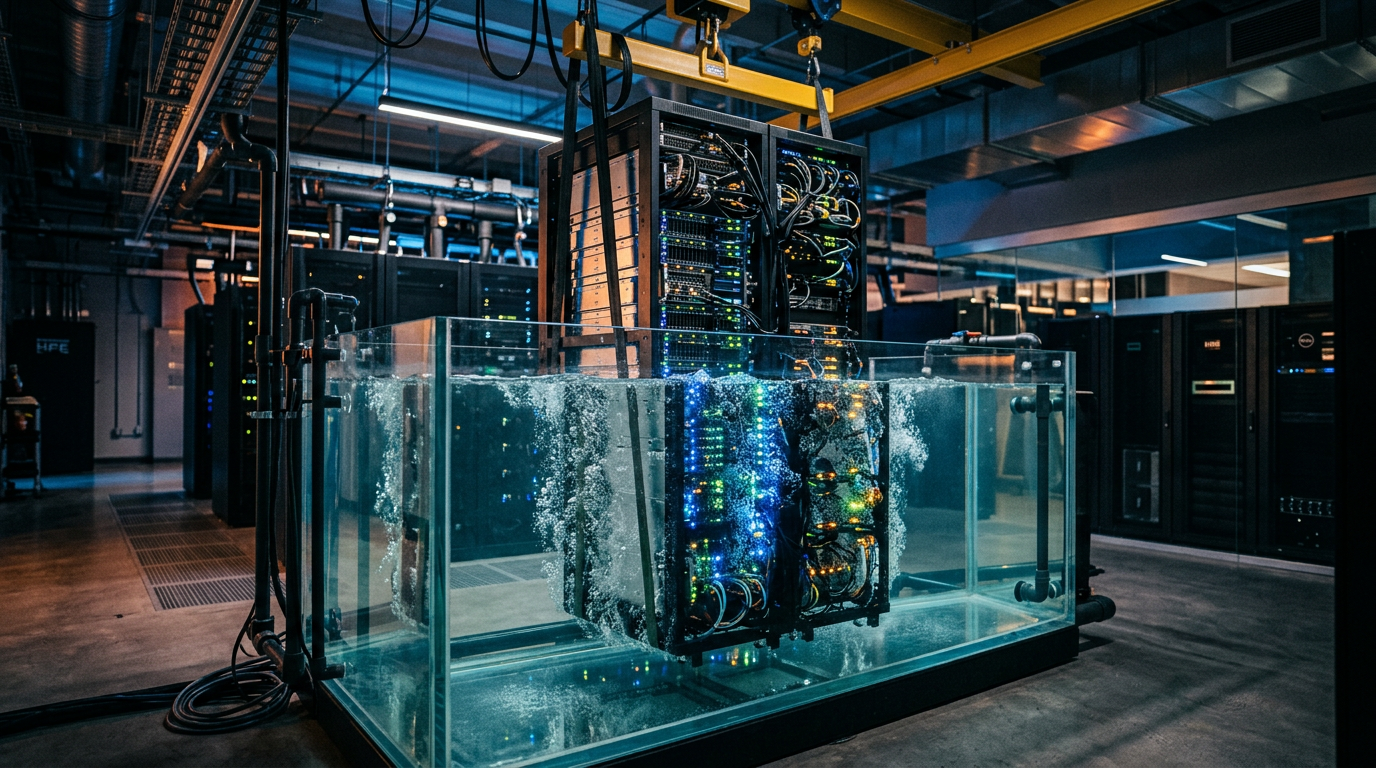
The air inside a hyperscale data center doesn't hum; it roars. It is a physical assault of sound, a constant hurricane generated by tens of thousands of fans fighting a battle against the fundamental laws of physics. For decades, the story of computing has been one of ethereal, abstract progress measured in floating-point operations and parameters. We speak of 'the cloud' as if it were a weightless, placeless entity. But the foundation of our digital world, and especially the burgeoning realm of artificial intelligence, is forged in heat—a furious, relentless byproduct that has become the single greatest barrier to computational progress.
Every transistor flip, every calculation that allows a large language model to compose a sonnet or a diffusion model to paint a masterpiece, dissipates energy as heat. For years, Moore's Law gave us an elegant escape: as transistors shrank, their power needs did too, allowing us to pack them ever denser. That era is over. While chips continue to grow in computational capacity, their power consumption, and thus heat output, is skyrocketing. An NVIDIA H100 GPU, the current workhorse of the AI revolution, has a Thermal Design Power (TDP) of 700 watts. A single rack of these accelerators can draw over 30 kilowatts—more than ten times the average of a decade ago. The next generation will push past 100 kilowatts per rack. Trying to cool this inferno with cold air alone is like trying to put out a bonfire with a handheld fan.
This thermal bottleneck is forcing a radical reimagining of the physical architecture of intelligence. The race to build the most powerful AI is no longer just about designing the cleverest algorithms or the fastest silicon; it is now a gritty, industrial battle waged over thermodynamics, fluid dynamics, and geography. A new economy is emerging, built not on code, but on coolant.
I. The Physics of Digital Thought
The link between information and energy is not merely an engineering problem; it is a physical principle. In 1961, physicist Rolf Landauer postulated that any logically irreversible manipulation of information, such as erasing a bit, must dissipate a minimum amount of energy as heat. While the Landauer limit is infinitesimally small for a single bit, the trillions upon trillions of operations happening every second inside an AI training cluster turn this theoretical floor into a very practical furnace. The more complex the model, the more data it processes, the more heat it generates.
For half a century, the industry's solution was brute force: Computer Room Air Conditioning (CRAC) units. These colossal systems function like oversized refrigerators, chilling vast volumes of air, forcing it under a raised floor, up through perforated tiles, and into the fronts of server racks. The hot exhaust is then sucked away, cooled, and recirculated. This method is notoriously inefficient. A significant portion of the energy goes into cooling the empty space of the room, not the chips themselves. The industry metric for this is Power Usage Effectiveness (PUE), a ratio of the total facility power to the power used by the IT equipment. A perfect score is 1.0. A typical air-cooled data center might achieve a PUE of 1.6, meaning 60% of the energy consumed by the IT equipment is spent again on cooling and other overhead.
As server rack power density climbed into the double-digit kilowatts, this model began to buckle. Air is a poor medium for heat transfer compared to liquid. The sheer volume of air required to cool a high-density rack becomes unmanageable, creating 'hot spots' where servers throttle their performance or shut down entirely to avoid damage. The industry had hit a thermal wall, and the only way through was to get wet.
II. From Air to Immersion
The first step away from the tyranny of air was direct-to-chip liquid cooling. This approach, akin to the radiator in a car, uses a network of tubes to pipe a coolant (usually a water-glycol mixture) directly to cold plates mounted on the hottest components like CPUs and GPUs. The liquid absorbs the heat far more effectively than air and carries it away to be dealt with elsewhere, either through a heat exchanger or an external radiator. This method allows for much denser server configurations and can bring PUEs down to the 1.2 range. It is a significant improvement, but for the triple-digit kilowatt racks on the horizon, even this is not enough.
“We've spent fifty years making chips faster. We'll spend the next twenty figuring out how to stop them from melting. The map of computational power will be redrawn by thermal advantage.”
The most radical, and increasingly necessary, solution is total immersion. Instead of bringing the coolant to the chip, you bring the entire server to the coolant. Racks of hardware are submerged in large tanks filled with a specially engineered dielectric fluid—a liquid that is an excellent thermal conductor but a poor electrical one, preventing short circuits. This method provides total, uniform cooling to every single component on a motherboard, from the mighty GPU to the tiniest resistor.
Two-phase immersion cooling is particularly elegant. As the fluid boils on the surface of the processors, it undergoes a phase change, absorbing a massive amount of heat energy—the same principle that makes evaporative cooling (sweating) so effective. This passive cycle can cool racks exceeding 200kW in density while achieving PUEs approaching a near-perfect 1.02. What was once a niche technology for supercomputing curiosities is now being piloted and deployed by major cloud providers like Microsoft and Google as a potential standard for their future AI infrastructure.
III. The New Geopolitics of Computation
This shift in cooling technology has profound geopolitical consequences. For air-cooled facilities, the main geographic consideration was cheap, reliable electricity and low latency connections. For liquid-cooled facilities, the equation changes. The new prime real estate for computation is anywhere that is cold and has abundant water. The Nordic countries—Finland, Sweden, Norway, and Iceland—have become hotspots for data center construction, offering cool ambient temperatures for much of the year (enabling 'free cooling' for liquid systems), stable grids powered by hydropower, and favorable political climates.
Microsoft's data centers in Finland go a step further, integrating their liquid cooling systems with municipal district heating networks. The waste heat captured from their servers is not vented into the atmosphere but instead used to heat local homes and businesses, turning a liability into a valuable community asset. This symbiotic relationship represents a paradigm shift in data center design, from isolated energy sinks to integrated urban infrastructure.
Even more exotic locations are being explored. Microsoft's Project Natick, which successfully deployed and operated a data center on the seafloor off the coast of Scotland, leveraged the consistently cold ocean water as a highly efficient, free heat sink. While logistically complex, underwater data centers offer a tantalizing solution to both the cooling and real estate challenges faced by their terrestrial counterparts. As the demand for AI compute grows, the strategic value of icy fjords, deep seabeds, and even arctic territories will only increase.
| Cooling Method | Typical PUE | Water Usage (L/kWh) | Server Density (kW/rack) | Relative Upfront Cost |
|---|---|---|---|---|
| Legacy Air Cooling | 1.6 - 1.8 | 1.8 | < 10 kW | Base |
| Containment & Air Economizers | 1.3 - 1.5 | 1.6 | 10-15 kW | Medium |
| Direct-to-Chip Liquid | 1.1 - 1.25 | 0.4 | 40-80 kW | High |
| Single-Phase Immersion | 1.05 - 1.1 | < 0.1 | 100-150 kW | Very High |
| Two-Phase Immersion | < 1.03 | 0 | > 200 kW | Highest |
IV. The Emerging Coolant Economy
The rise of immersion cooling is creating a completely new supply chain for specialized chemicals. The dielectric fluids required are sophisticated formulations, engineered for high thermal conductivity, high boiling points (for single-phase) or low boiling points (for two-phase), material compatibility, and long-term stability. For years, this market was dominated by a handful of chemical giants like 3M with their Novec and Fluorinert product lines.
However, these fluids are often per- and polyfluoroalkyl substances (PFAS), a class of 'forever chemicals' facing intense regulatory scrutiny and public backlash due to their environmental persistence and potential health risks. In a landmark decision, 3M announced it would exit all PFAS manufacturing by the end of 2025. This has sent shockwaves through the nascent immersion cooling industry, creating an urgent scramble for new, more sustainable, and bio-degradable coolant formulations. Startups and chemical companies are now racing to develop fluids based on synthetic esters or refined mineral oils that can match the performance of PFAS-based coolants without the environmental baggage.
This material science race is as critical to the future of AI as silicon lithography. The company that develops a cheap, effective, and environmentally benign dielectric fluid will hold a key that unlocks the next generation of super-dense, hyper-efficient computation. The market for these liquids, once a rounding error in the chemical industry, is now projected to explode, creating a new nexus of power where material science and information technology meet.
Projected Global Data Center Liquid Cooling Market Size (USD Billions)
The ethereal nature of artificial intelligence is a convenient illusion. In reality, it is a profoundly physical process, tethered to the Earth by its insatiable demand for energy and its consequent production of heat. As we push our digital ambitions ever further, we are not approaching an abstract singularity but a very concrete thermodynamic limit. Overcoming it will require more than just clever code. It will require breakthroughs in chemistry, a redrawing of the global map of infrastructure, and a fundamental acceptance that even our most advanced digital thoughts are constrained by the messy, physical laws of our world. The future of AI will not be written in the cloud; it will be submerged in a tank of engineered liquid, humming quietly in the cold.
Related Reading
Featured Research
Beyond Lithium: How Common Salt Is Quietly Powering the Next Battery Revolution
7 min read
The End of the Farm as We Know It: The Quiet Revolution of Precision Fermentation
7 min read

The Silent Terminals: What Ghost Airports Reveal About Our Broken Dreams of Flight
7 min read

The Living Breakwaters Remaking Our Carbon-Soaked Coastlines
6 min read