The Digital Harvest: Who Owns the Data From a Smart Farm?
As AI-driven precision agriculture promises a new green revolution, farmers are discovering they may be sowing the seeds of their own digital serfdom on their own land.
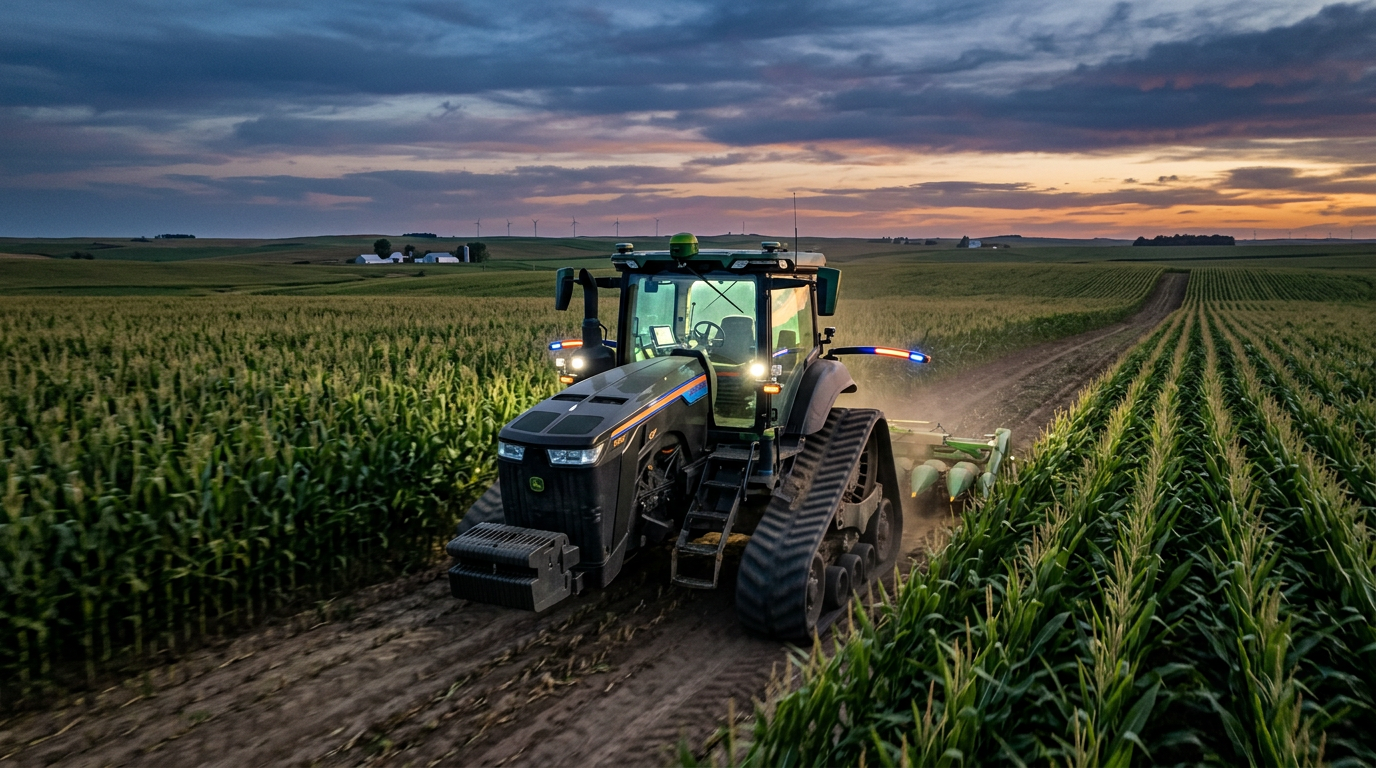
The sun sets over a 2,000-acre soybean farm in central Iowa, painting the sky in strokes of orange and purple. But the farmer, a fourth-generation operator named David Koehler, is not winding down. Instead, he’s watching a screen. On his tablet, a constellation of green dots moves in perfect, overlapping lines across a satellite map of his fields. Each dot is a data point, representing a specific square metre of soil, and the autonomous sprayer navigating the rows outside is responding to them in real time. It delivers a micro-dose of fungicide to one plant, a burst of nitrogen to another, and nothing at all to a third, all based on a complex algorithm fed by drone imagery and soil sensor readings from earlier that day. This is the face of 21st-century agriculture: hyper-efficient, data-driven, and managed by algorithm.
This technological leap, known broadly as precision agriculture, is far more than an upgrade from the plough. It represents a fundamental rewiring of how food is produced. Proponents, primarily the technology and equipment behemoths like John Deere, Bayer, and Trimble, promise a utopia of efficiency. By treating each plant, rather than each field, as the unit of management, they claim farmers can increase yields by up to 15%, while drastically reducing the use of water, fertilizers, and pesticides. In a world with a burgeoning population and an increasingly fragile climate, the pitch is nearly irresistible. Yet as farmers across the globe adopt these smart systems, a question as old as agriculture itself is resurfacing with a digital-age urgency: who controls the land? Or more accurately, who controls the data that the land now yields?
I. Anatomy of the Algorithmic Field
To understand the conflict, one must first grasp the sheer volume and variety of information being extracted from the modern farm. The ecosystem of a 'smart farm' is an intricate network of interconnected hardware and software. High-resolution GPS, accurate to within a single centimeter, guides autonomous tractors, planters, and harvesters, ensuring no overlap and no missed rows. These machines themselves are rolling data centers. A modern combine harvester, for instance, generates a 'yield map' as it moves, recording the productivity of every square metre of the field. It simultaneously logs fuel consumption, engine performance, and mechanical stress, sending terabytes of operational data back to the manufacturer.
Above, drones equipped with multispectral or LiDAR cameras scan the crops, detecting subtle variations in plant health, water stress, or pest infestation long before the human eye could. Below ground, a grid of IoT (Internet of Things) sensors provides a continuous stream of information on soil moisture, temperature, and nutrient composition. All this data is aggregated in a cloud platform—often a proprietary one like the John Deere Operations Center or Bayer’s Climate FieldView—where machine learning algorithms process it. The AI then generates 'prescriptions': precise, variable-rate application maps that tell the machinery exactly what to apply, where, and when.
The operational benefits for the individual farmer are clear. What is less obvious, and far more consequential, is the immense value of this data when aggregated. One farm’s soil data is useful; the soil data from ten thousand farms across the American Midwest is a strategic asset of unimaginable worth. This aggregated dataset can be used to build predictive models for crop yields that can move global commodity markets. It can inform a seed company on exactly where its new genetically modified corn variety thrives and where it fails, providing an immense competitive advantage. It gives an equipment manufacturer unparalleled insight into how and when its machinery breaks down, allowing for predictive maintenance models that lock customers into its service ecosystem.
II. The New Digital Land Barons
This is where the bargain begins to look less like a partnership and more like a form of digital sharecropping. The farmer provides the land, the labor, and the raw material—the data—while the technology provider owns the platform that refines and monetizes it. The fine print in the user agreements for these powerful platforms often reveals a startling reality. When a farmer uploads their field data to a corporate cloud, they are frequently granting the company a broad, irrevocable, and royalty-free license to use, aggregate, and create derivative works from that data.
John Deere, the world's largest manufacturer of agricultural machinery, has been at the center of this controversy. Its licensing agreements have historically been opaque and tilted heavily in the company's favor. While recent updates claim that farmers 'own' their data, the licenses they grant to Deere still give the company expansive rights to anonymize, aggregate, and commercialize it. It's a model of 'you own it, but we control it.' Farmers may generate the data on their own land, using their own equipment, but they often cannot easily move it to a competing platform or use it with a third-party analytics service. The data is effectively siloed within the manufacturer’s ecosystem.
“These are contracts of adhesion. You're a farmer, you've just spent half a million dollars on a new combine, and you can't use it unless you click 'agree'. It's not a negotiation. It's a surrender.”
This fight over data is inextricably linked to the 'right to repair' movement, another battleground where farmers have clashed with equipment manufacturers. Just as companies use proprietary software to prevent farmers or independent mechanics from repairing their own tractors, they use proprietary data formats and platforms to prevent them from having full control over their own operational information. The result is a powerful lock-in effect. Once a farmer invests in a particular brand of equipment and commits years of data to its platform, the cost and complexity of switching to a competitor become prohibitively high. They are tethered to a single provider for everything from machinery and software to financing and service.
III. Forging Data Sovereignty
But farmers are not passive actors in this digital transformation. A growing movement is pushing for 'agricultural data sovereignty.' This pushback is materializing on multiple fronts, from legal challenges and legislative lobbying to the creation of alternative, farmer-centric technology platforms. At the federal level in the United States, advocates are pushing for new legislation that would enshrine farmers' rights to data portability and transparency, similar to the GDPR's effect in Europe.
Perhaps the most promising developments are happening at the grassroots level. Farmer-owned cooperatives, a fixture of American agriculture for over a century, are entering the digital fray. Organizations like the Land O'Lakes-affiliated Truterra are building their own data analytics platforms. Unlike their corporate counterparts, these co-ops operate on a different model. The data remains the property of the farmer, and any benefits derived from aggregating that data flow back to the cooperative's members, not to external shareholders. They offer a compelling alternative by aligning the platform's incentives with those of its users.
Simultaneously, a new wave of independent AgTech startups is emerging, seeing a business opportunity in being the 'farmer's champion.' These companies offer software solutions (SaaS) that are brand-agnostic, meaning they can pull in data from John Deere tractors, Case IH sprayers, and Trimble GPS systems alike. Their entire value proposition is built on giving the farmer a unified, transparent view of their operation, free from the walled garden of a single manufacturer.
| Platform Model | Primary Data Owner | Data Portability | Monetization Strategy |
|---|---|---|---|
| Corporate (e.g., John Deere) | Farmer 'owns', but grants wide license to corporation | Low; data often siloed in proprietary formats | Hardware sales, service subscriptions, and monetization of aggregated data |
| Cooperative (e.g., Truterra) | Farmer Member | Moderate to High; data shared within the co-op network | Membership fees; benefits from aggregated insights returned to members |
| Independent SaaS (e.g., FarmLogs) | Farmer | High; designed for interoperability with multiple brands | Software subscription fees; no monetization of user data |
| Open-Source Initiative | Farmer / Community | Very High; built on open standards for maximum control | Community-driven; potential for grants or support contracts |
These competing models present a critical choice for farmers. Do they opt for the seamless, but restrictive, integration of a single corporate ecosystem? Or do they piece together a more open, but potentially more complex, system that guarantees their control over their most valuable new asset?
IV. The Future of the Fields
The market for these technologies is exploding. As the global agricultural sector rushes to adopt these tools, the window for establishing fair and equitable rules of the road is closing. The decisions made today about data governance on the farm will have ramifications for decades to come, shaping not just the economics of farming but the structure of our global food system.
Projected Global Precision Agriculture Market Size
The conflict over farm data is a microcosm of a much larger societal struggle. As AI and data analytics permeate every industry, from medicine to manufacturing, we are repeatedly confronted with the same fundamental questions about ownership, control, and equity. The farmer in his field, watching dots on a screen, is not an isolated figure. He is on the front line of a defining battle of the 21st century: the fight to ensure that the efficiencies of the digital world do not come at the cost of the autonomy of the individual. The harvest is no longer just about corn or soy; it is about data. And the question of who gets to reap its benefits remains dangerously unresolved.
Related Reading

Featured Research

Beyond Lithium: How Common Salt Is Quietly Powering the Next Battery Revolution
7 min read
The End of the Farm as We Know It: The Quiet Revolution of Precision Fermentation
7 min read

The Silent Terminals: What Ghost Airports Reveal About Our Broken Dreams of Flight
7 min read

The Living Breakwaters Remaking Our Carbon-Soaked Coastlines
6 min read