The Living Breakwaters Remaking Our Carbon-Soaked Coastlines
As sea levels rise, cities are abandoning hard concrete for soft, living infrastructure that invites nature back to defend the urban shoreline from a changing climate.
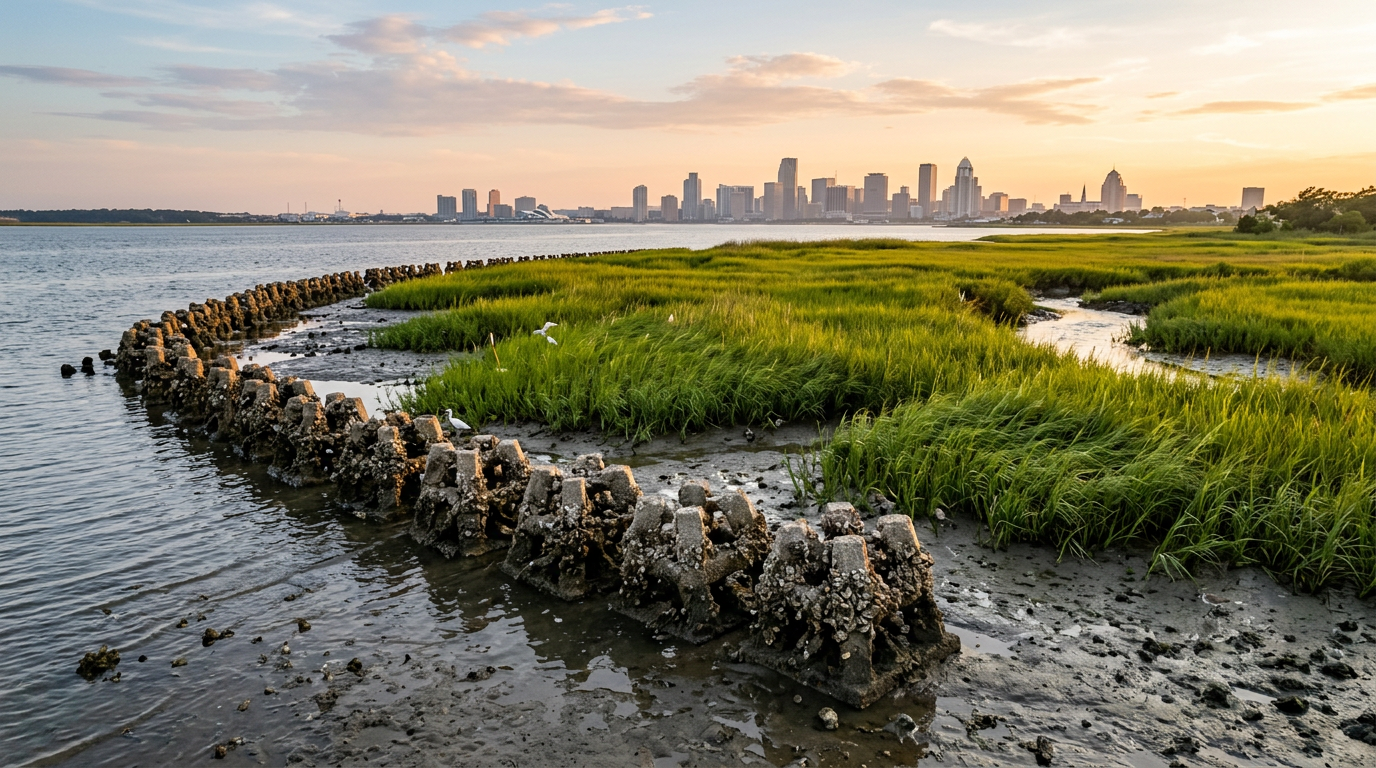
For centuries, the story of humanity's relationship with the sea has been one of conflict, fought along a hard, unyielding line. We built walls to keep the water out. From the ancient dikes of the Netherlands to the concrete promenades of Miami, 'grey infrastructure' was the universal answer to the ocean's persistent advance. This was engineering as dominion: a rigid, brute-force declaration of where the land ended and the sea began. But in an era of accelerating climate change and rising sea levels, the walls are beginning to show their cracks, both literally and metaphorically. The very structures designed to protect us are, in many cases, making our coastlines more vulnerable.
The problem with a seawall is its sheer refusal to yield. When a wave hits a vertical concrete surface, its energy is not absorbed; it is reflected back with nearly equal force. This turbulence scours the seabed at the base of the wall, deepening the nearshore waters and undermining the wall's own foundation. Over time, the beach in front of the wall disappears, a phenomenon known as 'coastal squeeze'. The vibrant intertidal zone—that life-rich ribbon of sand and mud that is home to countless species—is annihilated. A seawall turns a dynamic ecosystem into a sterile, aquatic cul-de-sac.
I. The Failure of the Grey Fortress
The evidence of this failing paradigm is washing up on shores globally. In coastal Louisiana, the combination of land subsidence and sea level rise has overwhelmed levees, leading to catastrophic wetland loss. Along the United Kingdom's eroding coast, towns have been forced into 'managed retreat', abandoning properties to the sea as the cost of maintaining Victorian-era concrete defenses becomes untenable. These structures offer a false sense of security. They are engineered for a specific 'design storm', a statistical threshold that is being crossed with increasing frequency in our supercharged climate. When a storm surpasses that threshold, the failure is not gradual; it is often catastrophic.
Furthermore, the ecological cost is immense. Grey infrastructure creates a hard barrier that fragments habitats. Fish nurseries, foraging grounds for wading birds, and filter-feeding shellfish beds are replaced by a biologically inert surface. This approach not only fails to protect us in the long run but also actively degrades the natural systems that provide their own, more resilient forms of protection for free. It is a solution born of an industrial-age mindset, one that viewed nature as a resource to be tamed or an obstacle to be paved over. That mindset is now costing us dearly.
II. Engineering with Nature's Blueprint
A new philosophy is taking root, one that seeks not to fight the ocean but to partner with it. It goes by many names—'nature-based solutions', 'soft engineering', 'ecological engineering'—but the most evocative is 'living shorelines'. The core principle is simple and profound: use natural habitats and processes to provide coastal defense, while simultaneously restoring ecological function. Instead of reflecting wave energy, living shorelines are designed to dissipate it.
Imagine a natural coastline. A wave rolling in from the open ocean first encounters an offshore reef, which trips it up and breaks its power. It then moves through a kelp forest or seagrass bed, where the friction of vegetation slows it further. Finally, it washes into the complex, textured roots of a mangrove forest or the dense stems of a salt marsh, its remaining energy gently absorbed. A living shoreline is a deliberate attempt to reconstruct this layered, energy-dissipating system in a place where it has been lost, or to create a new one where it is needed.
“We're moving from a purely defensive posture to one of co-creation. It's not just about stopping water; it's about curating a healthier, more resilient coastal system that provides multiple benefits. We protect the shore, yes, but we also get cleaner water, more fish, and carbon sequestration. It's a systemic win.”
The toolkit for this new coastal engineering is drawn from nature itself. It might involve creating offshore breakwaters from interlocking concrete forms designed to mimic coral reefs, providing surfaces for oysters and mussels to colonize. These 'oyster castles' or 'reef balls' quickly become living structures, their rough, complex surfaces baffling waves far more effectively than flat concrete. Behind this initial line of defense, shoreline managers will plant salt-tolerant grasses like Spartina, their dense root systems binding the sediment and preventing erosion. In tropical climes, the focus turns to restoring mangrove forests, known as 'bioshields' for their incredible ability to buffer coastlines from storm surges.
III. A Global Laboratory of Living Shorelines
This is not theoretical. Around the world, ambitious projects are demonstrating the power of this approach. One of the most prominent is the Living Breakwaters project off the coast of Staten Island in New York. Ravaged by Hurricane Sandy in 2012, the community opted against a bigger wall. Instead, they are building a 2,400-foot-long system of offshore reef-like breakwaters. Designed by the landscape architecture firm SCAPE, the project is engineered to reduce wave action, prevent erosion, and, crucially, to become a living habitat for oysters, fish, and other marine life. It is defense as an act of ecological restoration.
In Singapore, an island nation where nearly a third of the land is reclaimed from the sea, the government is experimenting with bio-integrated seawalls. Instead of sheer vertical faces, new coastal defenses are being built with textured panels, engineered crevices, and tidal pools designed to encourage colonization by marine organisms. The goal is to turn inert structures into thriving 'vertical reefs', enhancing biodiversity and creating a more resilient and attractive waterfront. It's a pragmatic recognition that in a dense urban environment, grey and green must learn to coexist and even merge.
Meanwhile, in places like Bangladesh and Vietnam, large-scale mangrove restoration projects funded by international climate adaptation funds are providing a vital buffer for millions of people living in low-lying deltas. These projects are not only more cost-effective than building and maintaining concrete embankments, but they also support local livelihoods through sustainable fishing and aquaculture within the restored forests. They are sequestering carbon at rates far higher than terrestrial forests and rebuilding the very land on which communities depend.
| Feature | Grey Infrastructure (e.g., Seawall) | Green Infrastructure (e.g., Living Shoreline) |
|---|---|---|
| Primary Function | Block and reflect wave energy | Absorb, dissipate, and attenuate wave energy |
| Habitat Impact | Destroys intertidal habitat; 'coastal squeeze' | Creates and restores habitat for fish, birds, and invertebrates |
| Storm Performance | Prone to catastrophic failure beyond design threshold | Resilient; reduces wave energy, performance degrades gracefully |
| Long-term Cost | High upfront cost plus ongoing, expensive maintenance | Higher initial design/build cost, but self-maintaining and can grow stronger over time |
| Co-Benefits | Few to none; primarily single-purpose | Water filtration, carbon sequestration, fisheries enhancement, recreation |
| Adaptability | Static; difficult and costly to modify for rising seas | Can be designed to adapt and self-accrete sediment, naturally building elevation |
IV. The Challenges Ahead
Despite these successes, the transition from grey to green is not without its challenges. Living shorelines are not a panacea. They are best suited for low to medium-energy wave environments, typically within estuaries and bays. The open coast, battered by high-energy ocean swells, may still require more robust, hybrid approaches that combine green elements with grey 'bones'. Site selection is critical, and a project that works in one location may fail in another.
There are also regulatory and institutional hurdles. Many municipal planning codes are written with hard infrastructure in mind, making it difficult to get permits for novel, 'soft' solutions. Living shorelines can also take time to establish—a marsh planted today may take several years to reach its full protective capacity, a timeline that can feel unnervingly long for vulnerable communities. This requires a shift in political thinking, away from ribbon-cutting ceremonies for concrete projects and towards patient, long-term investment in natural capital.
Biodiversity Return at a Restored Estuary Site (5-Year Data)
Perhaps the greatest challenge is one of expertise. This new approach demands a new kind of professional, one who is as comfortable with hydrology and structural engineering as they are with benthic ecology and sediment transport. Universities are just beginning to develop programs that bridge these disciplinary divides. The future of our coastlines depends on training this next generation of ecological engineers who can speak both the language of concrete and the language of coral.
The era of holding a rigid line against the sea is over. The ocean is not an enemy to be conquered, but a powerful, dynamic system that we must learn to accommodate. Living shorelines represent more than just a clever engineering technique; they represent a fundamental shift in our relationship with the natural world. Instead of seeking to dominate, we are learning to collaborate. By weaving life back into the fabric of our cities, we are discovering that resilience is not about rigidity and strength, but about flexibility, diversity, and the profound power of a living system to heal itself.
Related Reading
Featured Research

Beyond Lithium: How Common Salt Is Quietly Powering the Next Battery Revolution
7 min read

The End of the Farm as We Know It: The Quiet Revolution of Precision Fermentation
7 min read
The Silent Terminals: What Ghost Airports Reveal About Our Broken Dreams of Flight
7 min read

The Digital Harvest: Who Owns the Data From a Smart Farm?
7 min read