The Complete Guide to Fusion Energy: Will It Power Our Future?
From recreating the sun on Earth to the promise of limitless clean power, this guide breaks down the science, key players, and massive hurdles of fusion energy.
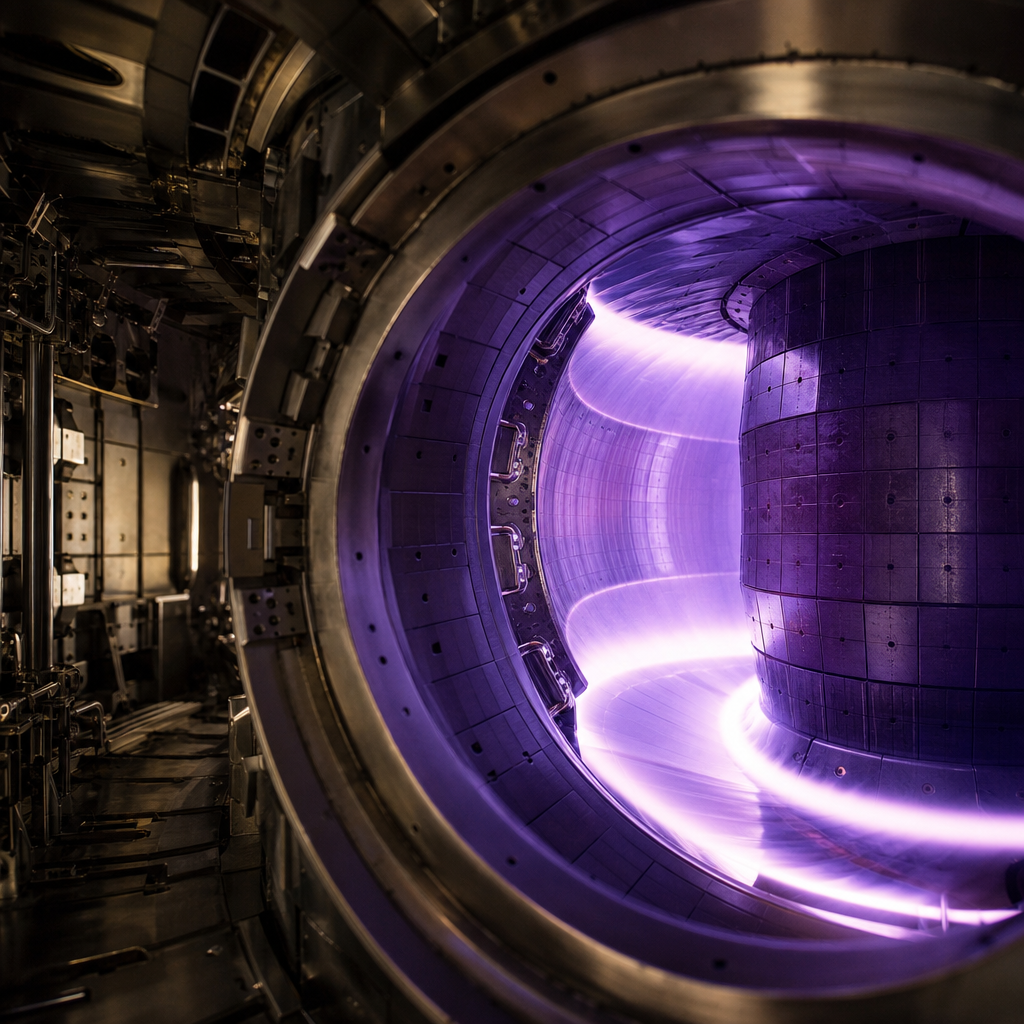
Fusion energy is the process of generating power by fusing together light atomic nuclei, the same reaction that powers the sun and stars. The pursuit of fusion energy on Earth aims to provide a virtually limitless, safe, and carbon-free source of power. While scientists recently achieved a landmark 'net energy gain' for the first time, significant scientific and engineering challenges mean commercial fusion power plants are still likely decades away from contributing to our electrical grids.
What Is Fusion Energy? A Sun in a Bottle
At its heart, nuclear fusion is the universe’s most fundamental energy source. It is the process where two light atomic nuclei combine to form a single, heavier nucleus, releasing a massive amount of energy. This is the opposite of nuclear fission, the process used in today's nuclear power plants, which splits heavy atomic nuclei (like uranium) apart. While both processes release energy governed by Einstein's E=mc², fusion's inputs are far more abundant and its outputs are significantly cleaner and safer.
The fuel for the most common type of fusion reaction, deuterium-tritium (D-T), is readily available. Deuterium is a stable isotope of hydrogen that can be easily extracted from seawater—the oceans contain enough to power humanity for millions of years. Tritium is a radioactive isotope of hydrogen with a short half-life, which doesn't occur naturally in significant quantities. However, it can be 'bred' inside the fusion reactor itself from lithium, an element found abundantly in the Earth's crust. Famously, the lithium in a single laptop battery, combined with deuterium from about 45 litres of water, could produce the same amount of energy as burning 70 tonnes of coal.
How Fusion Reactors Work: Tokamaks vs. Stellarators
To achieve fusion on Earth, you need to overcome the immense electrostatic repulsion between positively charged atomic nuclei. This requires creating and confining a state of matter called a plasma, an ionized gas heated to temperatures exceeding 150 million degrees Celsius (about 270 million degrees Fahrenheit)—ten times hotter than the core of the sun. Keeping this superheated plasma stable and preventing it from touching the reactor walls (which would instantly vaporise them) is the central engineering challenge of fusion.
Two main designs for magnetic confinement fusion have dominated the field. The most common is the tokamak, a Russian invention shaped like a doughnut. It uses powerful magnetic coils to suspend the plasma in a torus, while a central solenoid induces a current in the plasma itself, heating it and helping to confine it. Projects like the massive international ITER experiment in France and the UK's former Joint European Torus (JET) are tokamaks. The second design is the stellarator, a more complex, twisted doughnut shape. It uses a series of external magnets with an intricate, asymmetrical geometry to confine the plasma without needing to drive a large current within it. While harder to design and build, stellarators are theoretically more stable and can operate in a steady state, unlike the pulsed nature of many tokamaks. Germany's Wendelstein 7-X is the world's most advanced stellarator.
The Promise: Key Benefits of Fusion Power
The primary driver for the multi-billion dollar, decades-long quest for fusion is its potential as the ultimate clean energy source. Once operational, a fusion power plant would produce zero greenhouse gases. Its fuel is abundant, and it would provide a constant, reliable source of baseload power, complementing the intermittency of renewables like solar and wind.
Safety is another enormous advantage. The fusion process is inherently safe. There is no possibility of a runaway chain reaction or meltdown as seen in fission accidents like Chernobyl or Fukushima. The amount of fuel in the reactor at any one time is tiny—only a few grams—and any disruption to the precise conditions required for the reaction causes the plasma to cool down in seconds and the reaction to stop. While D-T fusion does produce high-energy neutrons that make the reactor's inner wall materials radioactive, this 'activation' involves materials with much shorter half-lives than the waste from fission plants. Most components would be safe to handle and recycle within a century.
“We're not just building a power plant; we're trying to domesticate a star. The engineering is arguably the greatest challenge humanity has ever undertaken, but the payoff is a clean, sustainable future for civilisation.”
The Hurdles: Why Isn't Our Grid Fusion-Powered Yet?
If fusion is so great, why don't we have it? The answer lies in a set of overlapping scientific and engineering challenges of mind-boggling complexity. The first is achieving sustained, high-yield net energy gain. While NIF's achievement was historic, it was for a brief moment in an experimental setup. A commercial power plant needs a Q value of 10 or more, sustained for long periods, to be economically viable.
The second major hurdle is materials science. The inner 'first wall' of a reactor must withstand a constant bombardment of high-energy neutrons, which can degrade materials over time, making them brittle and radioactive. Scientists are racing to develop new alloys and composites that can survive these extreme conditions for years. Third is the challenge of tritium breeding. A commercial reactor must create its own tritium fuel faster than it consumes it, a process that has yet to be demonstrated at scale. Finally, there is the sheer cost. ITER, a multinational research project, has a price tag exceeding €20 billion and has been under construction for over a decade. Private companies are betting they can build smaller, more efficient, and cheaper reactors, but this remains to be proven.
| Fuel Cycle | Required Temperature (Million °C) | Relative Energy Output | Neutron Production |
|---|---|---|---|
| Deuterium-Tritium (D-T) | 100 - 150 | High | High (80% of energy) |
| Deuterium-Deuterium (D-D) | 400 - 500 | Medium | Moderate (~40% of energy) |
| Deuterium-Helium-3 (D-He3) | 500 - 600 | Medium | Low |
| Proton-Boron-11 (p-B11) | > 1,000 | Low | Virtually None (Aneutronic) |
Who Is Leading the Race for Fusion?
The fusion landscape is divided between large-scale public initiatives and a vibrant, fast-moving private sector. The undisputed giant is ITER (International Thermonuclear Experimental Reactor) in Saint-Paul-lès-Durance, France. A collaboration between China, the EU, India, Japan, South Korea, Russia, and the US, its goal is to be the first fusion device to produce net energy on a large scale (Q ≥ 10). It is a scientific proof-of-concept, not a power plant.
In parallel, a wave of private investment has supercharged the field. According to the Fusion Industry Association, private fusion companies have attracted over $6 billion in funding to date. Key players include Commonwealth Fusion Systems (CFS), an MIT spin-off, which is using revolutionary high-temperature superconducting magnets to build a much smaller, more powerful tokamak called SPARC. Helion Energy, backed by tech leaders like Sam Altman, is pursuing a different, pulsed approach that aims to generate electricity directly. In the UK, Tokamak Energy is also developing compact spherical tokamaks with high-temperature superconducting magnets. These private firms are generally more agile and are betting on novel technologies to leapfrog the slower, more conventional path taken by government projects.
Private Investment in Fusion Energy Companies
The Road Ahead: Milestones and Timelines
The path to a fusion-powered grid is a marathon, not a sprint, marked by critical milestones. The next major step for the entire field is the full operation of ITER, expected to achieve its first plasma in the late 2020s and full D-T operations in the mid-2030s. Its success or failure will reverberate across the industry. Following ITER, many nations plan to build DEMO (DEMOnstration Power Plant) reactors, like the UK's STEP (Spherical Tokamak for Energy Production) program, which aim to be the first to actually connect to the grid, slated for the 2040s.
Private companies are working on much more aggressive timelines. CFS hopes its SPARC experiment will prove net energy gain by 2025, paving the way for its first power plant, ARC, in the early 2030s. Helion also aims to demonstrate net electricity generation in the coming years. While these timelines are optimistic, the rapid technological progress—especially in magnets, materials, and AI-powered plasma control—is real. Most sober analysis suggests that even with breakthrough success, the 2040s are the earliest we might see the first commercial fusion plants, with widespread global deployment taking until the second half of the 21st century. Fusion is a long game, but it is one we must play for a truly sustainable energy future.
Frequently Asked Questions
Is fusion energy the same as nuclear fission?
No, they are opposites. Nuclear fission, used in current nuclear plants, splits heavy atoms like uranium to release energy. Fusion energy combines, or fuses, light atoms like hydrogen, releasing even more energy with abundant fuel and without producing long-lived radioactive waste.
Is fusion power dangerous or radioactive?
Fusion is considered inherently safe with no risk of a meltdown or runaway reaction. The most common fusion process (D-T) produces neutrons that make the reactor materials radioactive, but these materials have much shorter half-lives than fission waste and can be managed through material choice and recycling within about 100 years.
How much does a fusion reactor cost to build?
Current experimental reactors are extremely expensive. The international ITER project is estimated to cost over €20 billion. However, private companies and future designs for commercial power plants aim to dramatically reduce costs by using new technologies to build smaller, more efficient reactors.
What is the 'net energy gain' breakthrough?
Net energy gain (or a Q factor > 1) is achieved when a fusion reaction produces more energy than was used to heat the plasma and initiate the reaction. The National Ignition Facility (NIF) in the US first achieved this milestone in 2022, proving that the basic physics is possible and marking a historic moment for fusion research.
When can we expect to have fusion energy on the grid?
While some private companies have very optimistic targets in the 2030s, the broad consensus among scientists is that the first commercial fusion power plants will likely be connected to the grid in the 2040s or 2050s. Widespread adoption as a major energy source will take several decades beyond that.
How did this land?
Related Reading
More by this writer — Dr. Aris Thorne
→Featured Research
Solid-State vs. Lithium-ion Batteries: Which Technology Will Power the Future?
7 min read

9 Underrated European Cities to Visit Instead of the Crowds
9 min read

What Is Universal Basic Income and How Would It Work?
7 min read
Rewilding vs. Traditional Conservation: Which Is the Future of Biodiversity?
8 min read