The Sonic Ghosts of Ruin: Listening for Life in Post-Industrial Landscapes
Abandoned mines and factories are not silent; they are teeming with acoustic data that reveals a complex, often surprising story of ecological recovery invisible to the naked eye.
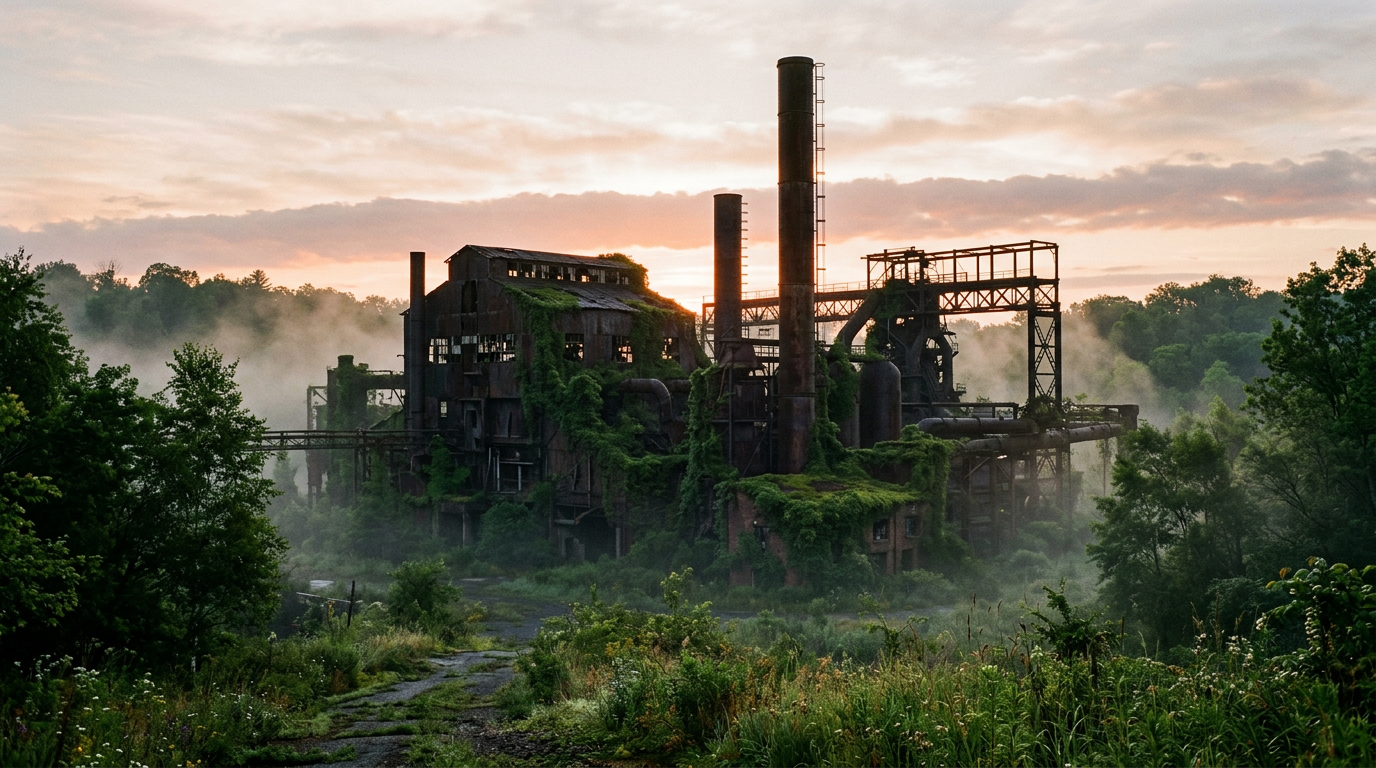
The Monongahela Valley south of Pittsburgh is a graveyard of American industry. Skeletal remains of blast furnaces and steel mills rust along the riverbank, monuments to a departed economic age. To the casual eye, these are places of decay, of silence. But if you stop and truly listen, especially at the threshold of day and night, the silence is a fiction. A high-pitched chorus of spring peepers erupts from a waterlogged pit where a quenching tower once stood. The complex, melodic song of a Carolina wren echoes from a girder thick with ivy. The buzz of pollinators, once drowned out by the roar of machinery, now defines the audible space. These are not just sounds; they are data. They are proof of life returning to landscapes we wrote off as terminal.
For decades, conservation has been a largely visual discipline. We count what we can see: trees planted, birds spotted through binoculars, animal tracks in the mud. But a burgeoning field known as soundscape ecology, or bioacoustics, argues that our ears may be far more powerful tools for understanding the health of an ecosystem. By deploying small, weatherproof microphones called Autonomous Recording Units (ARUs), researchers can capture the entire acoustic environment of a location—the 'soundscape'—continuously for months or even years. This acoustic data provides an unprecedentedly rich, nuanced, and continuous record of biodiversity, one that is revealing the slow, complicated rebirth of the world’s post-industrial wounds.
I. The Unseen Symphony
Every environment has a unique sonic signature, composed of three primary elements. 'Geophony' includes the non-biological sounds of the landscape: wind whistling through derelict structures, rain drumming on a rusty roof, water flowing in a remediated creek. 'Anthrophony' is the sound of humans—the distant hum of a highway, a passing train—which, in these post-industrial zones, is often a faint echo of the intense mechanical din that once dominated. But the real prize for ecologists is the 'biophony': the collective sound produced by all living organisms. It is the croak of a frog, the stridulation of a cricket, the chatter of a squirrel, the song of a bird. The richness, diversity, and complexity of the biophony is a direct proxy for the health and complexity of the ecosystem itself.
Dr. Stuart Gage, a pioneer in the field from Michigan State University, established that a healthy, mature ecosystem sounds like a symphony orchestra, with different species vocalizing in their own specific frequency bands and time slots to avoid masking each other. A degraded ecosystem, by contrast, sounds like a broken radio, with static, sparse signals, and little structure. Post-industrial sites begin in this degraded state. Initially, their soundscapes are dominated by geophony and the lingering ghosts of anthrophony. But as pioneer plant species colonize the bare soil, they create habitats for insects. The returning insects provide food for birds and bats, which then begin to fill the empty sonic niches with their calls. Listening to recordings captured over years allows scientists to hear this symphony reassembling itself, note by note.
The sheer volume of data is staggering. A single ARU can collect thousands of hours of audio in a year. Manually listening to it is impossible. The breakthrough has come from the application of artificial intelligence and machine learning. Algorithms can now sift through terabytes of sound, identifying the calls of specific species with remarkable accuracy. More importantly, they can compute indices that measure the overall health of the soundscape without needing to identify every single vocalist.
“We're moving beyond simple species counts. We're analyzing the textural properties of the entire soundscape. Is the biophony dense and structured, or is it sparse and chaotic? That tells us about ecosystem function, about the resilience of the web of life.”
II. From Rust to Richness: A Case from Appalachia
Consider the Black Creek Rehabilitation Project in southern West Virginia, a 500-acre site that was an active surface coal mine until 2005. Following regulatory closure, the land was re-graded and seeded with non-native grasses to control erosion, a standard but ecologically simplistic approach. Visually, for the first decade, it was a monotonous green desert. But a bioacoustics monitoring project initiated in 2012 by West Virginia University tells a different story.
Early recordings were sonically barren, dominated by wind. By 2015, however, the ARUs began picking up the distinctive calls of field sparrows and grasshopper sparrows—grassland specialists. More surprisingly, in water-collecting depressions, the algorithms detected the emergence of Fowler's toads. These amphibians were not intentionally reintroduced; their arrival indicated that the compacted soil and hydrology were beginning to recover on their own, creating micro-wetlands that ecologists on the ground hadn't even mapped yet.
The acoustic data provided crucial feedback for adaptive management. Hearing the arrival of grassland birds, land managers shifted their strategy from simple erosion control to actively promoting a more complex grassland and shrubland habitat. They stopped mowing certain areas and planted native berry-producing shrubs. The sonic response was almost immediate. The recordings from 2018-2020 show a marked increase in the diversity of birdsong, with the arrival of yellow-breasted chats and indigo buntings, species that require more structural complexity than open grass.
This approach highlights a new paradigm: restoration not as a fixed blueprint, but as a conversation with the landscape. The returning biophony tells managers what is working. It reveals the invisible processes—the establishment of an insect population, the subtle shift in hydrology—that are the true engines of recovery. It is a more patient, responsive, and ultimately more successful form of ecological healing.
III. Reading the Acoustic Fingerprint
The power of bioacoustics lies in its ability to capture the entire ecological community, not just the large and charismatic. Traditional surveys are heavily biased towards diurnal birds and large mammals. But the soundscape includes everyone. The nighttime chorus of katydids, crickets, and moths—a critical part of the food web—is fully captured. The high-frequency clicks of bats, inaudible to human ears but easily recorded by ARUs, paint a detailed picture of nocturnal insect hunting.
Analyzing the structure of this sound reveals even more. In a healthy ecosystem, a spectrogram—a visual representation of sound—shows distinct layers, with insects occupying certain frequencies, frogs others, and birds still others. This 'acoustic niche partitioning' is a sign of a mature, co-evolved community. In the early stages of recovery at a site like a former quarry, the spectrogram is often messy, with pioneer species calling over one another. As recovery progresses, order begins to emerge from the noise. The spectrogram becomes more structured, more symphonic.
This ability to assess 'function' in addition to 'composition' is revolutionary. It's not just about what species are present, but how they are interacting and sharing resources, in this case, acoustic space. It allows us to ask deeper questions: Is the returning ecosystem just a random collection of hardy species, or is it developing the complex internal structure that defines a resilient, self-sustaining system? Visual surveys alone can rarely answer this.
IV. The Data of Rebirth
As bioacoustics becomes more widespread, it is generating vast, comparable datasets on ecological recovery across the globe. Comparing the acoustic fingerprints of different types of post-industrial sites reveals patterns that can guide future restoration efforts everywhere, from the bauxite mines of Australia to the chemical plant brownfields of New Jersey.
| Site Location | Former Use | Years Since Closure | Mean Spring ACI | Notable Biophony Detected |
|---|---|---|---|---|
| Ruhr Valley, DE | Coal Processing Plant | 25 | 2850 | High diversity of songbirds, bats |
| Sudbury Basin, ON, CA | Nickel Smelter Area | 40 | 2400 | Boreal chorus frogs, returning thrushes |
| Cornwall, UK | China Clay Quarry | 15 | 3100 | Extremely high insect and amphibian chorus |
| Lehigh Gap, PA, USA | Zinc Smelter | 20 | 1950 | Pioneer grassland birds, low insect diversity |
| Don River Valley, ON, CA | Industrial Brownfield | 30 | 2675 | Complex urban adapter bird and insect community |
The table above demonstrates the variance in recovery trajectories. The former quarry in Cornwall, now home to the Eden Project, shows a remarkably high Acoustic Complexity Index (ACI) due to the rapid establishment of wetland and meadow habitats that support a booming invertebrate and amphibian population. In contrast, the former zinc smelter site in Pennsylvania, which suffered from decades of heavy metal contamination, shows a much slower acoustic recovery, dominated by a few hardy bird species. This comparative data is invaluable for setting realistic recovery targets and understanding which restoration techniques are most effective under different conditions of industrial damage.
Acoustic Complexity Index (ACI) at Black Creek Reclaimed Mine
The steady rise in the ACI at the Black Creek site, as shown in the chart, provides quantitative proof of the success of the adaptive management strategy. It transforms the abstract goal of 'improving biodiversity' into a measurable, trackable metric. This kind of hard data is essential for justifying investments in ecological restoration and for holding industries and governments accountable for their environmental stewardship commitments.
As we confront a future on a planet scarred by our industrial past and stressed by a changing climate, these wounded landscapes are becoming unlikely laboratories for regeneration. They are teaching us that recovery is possible, but that it follows its own timeline and its own logic. By learning to listen to the subtle, complex language of the returning biophony, we are not only charting their revival but are also relearning a fundamental skill: paying attention. The sonic ghosts of our industrial past are not haunting us; they are singing a quiet, persistent song of hope, telling us that even in the deepest ruin, life is waiting for its cue.
Related Reading

Featured Research

Beyond Lithium: How Common Salt Is Quietly Powering the Next Battery Revolution
7 min read

The End of the Farm as We Know It: The Quiet Revolution of Precision Fermentation
7 min read

The Silent Terminals: What Ghost Airports Reveal About Our Broken Dreams of Flight
7 min read

The Digital Harvest: Who Owns the Data From a Smart Farm?
7 min read