The Complete Guide to Dark Matter: Unveiling the Universe's Hidden Mass
Explore the enduring mystery of dark matter, its compelling evidence, and the global scientific quest to identify this elusive cosmic component.
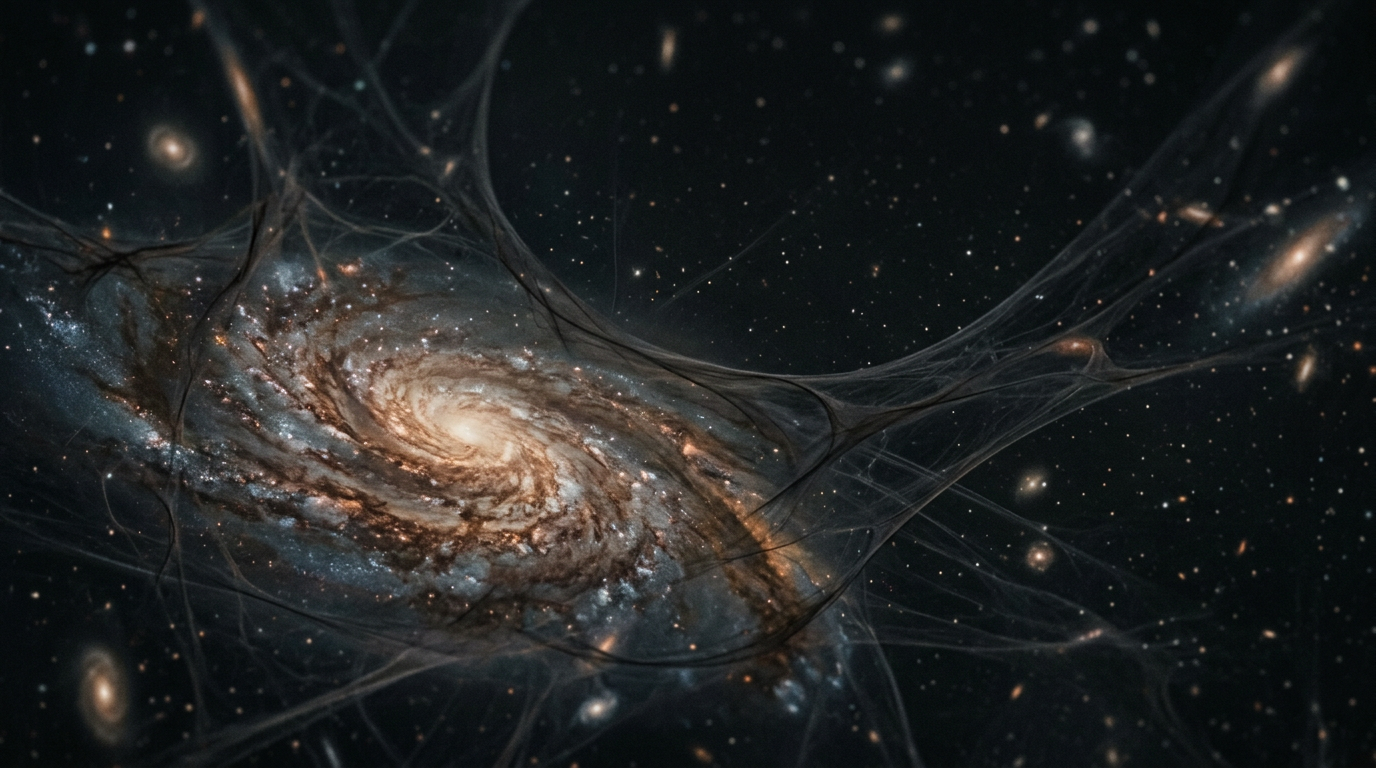
Dark matter is a hypothetical, non-luminous form of matter that, unlike ordinary matter, does not interact with light or other forms of electromagnetic radiation, making it invisible to telescopes. It is a fundamental component of the universe, currently estimated to constitute about 27% of its total mass-energy content, significantly outweighing the baryonic (ordinary) matter that makes up stars, planets, and ourselves. Its existence is inferred solely through its gravitational effects on visible matter, leading to some of the most profound puzzles in contemporary physics.
What is Dark Matter?
Dark matter is a mysterious substance that cannot be directly observed because it does not emit, absorb, or reflect light. Its discovery originated from astronomical observations that showed that galaxies and galaxy clusters required far more mass than could be accounted for by their visible stars and gas to maintain their observed dynamics. This 'missing' mass, which exerts gravitational pull but remains invisible, is what scientists refer to as dark matter. It is distinct from dark energy, which causes the accelerating expansion of the universe.
Unlike the protons, neutrons, and electrons that form ordinary matter, dark matter is thought to be composed of entirely new types of elementary particles. The Standard Model of particle physics, which describes the fundamental forces and particles, does not include a candidate for dark matter, making its identification one of the most pressing challenges in physics today. Its properties remain largely unknown, but leading theories suggest it interacts only weakly with normal matter, primarily through gravity.
Compelling Evidence for Dark Matter's Existence
While dark matter remains elusive, its gravitational fingerprints are everywhere, from the smallest galaxies to the largest cosmic structures. These observational cues have solidified its status from a theoretical curiosity to an indispensable component of cosmological models.
The pioneering work of Vera Rubin and Kent Ford in the 1970s on galactic rotation curves provided the most direct early evidence. They observed that stars at the outer edges of spiral galaxies orbit at roughly the same speed as stars closer to the galactic centre, defying Newtonian mechanics which predicted they should slow down. This anomaly indicated the presence of a vast, invisible 'halo' of mass extending far beyond the visible starlight, generating the necessary gravitational pull to keep the outer stars moving so fast.
Gravitational lensing is another powerful piece of evidence. This phenomenon, predicted by Einstein's theory of general relativity, occurs when massive objects, such as galaxy clusters, bend the path of light from background sources. The observed degree of lensing is often significantly stronger than what can be explained by the visible matter alone, suggesting a substantial hidden mass distribution – consistent with dark matter. The Hubble Space Telescope has captured stunning images of these lensing effects, providing quantitative data supporting dark matter's presence.
“The universe is playing a profound game of hide-and-seek with us. Dark matter is not just a missing piece of the cosmic puzzle; it is the puzzle itself, dictating how galaxies form and evolve.”
Furthermore, the detailed analysis of the Cosmic Microwave Background (CMB) – the faint afterglow of the Big Bang – provides crucial insights. Fluctuations in the CMB radiation, as measured by missions like the Planck satellite, are exquisitely sensitive to the total matter content and distribution in the early universe. Cosmological models that accurately reproduce these fluctuations invariably require a significant component of non-baryonic dark matter, comprising approximately 27% of the universe's critical density, and about 85% of its total mass.
Leading Dark Matter Candidates
Scientists have proposed various types of particles that could constitute dark matter, each with distinct properties that guide experimental searches. The most popular candidates fall into two broad categories:
Weakly Interacting Massive Particles (WIMPs) are hypothetical particles that interact with normal matter only through gravity and the weak nuclear force. This makes them incredibly difficult to detect, but also explains why they don't emit light. WIMPs are theoretically predicted by extensions to the Standard Model, such as Supersymmetry (SUSY), which posits a heavier 'superpartner' for every known particle. WIMPs typically have masses hundreds to thousands of times that of a proton, enabling direct detection experiments.
Axions are much lighter, hypothetical particles initially proposed to solve a different problem in particle physics known as the 'strong CP problem'. While much less massive than WIMPs, they could still account for dark matter if they are sufficiently numerous. Axions would interact even more weakly than WIMPs, requiring different detection techniques, often involving strong magnetic fields.
Other possibilities include Sterile Neutrinos, which are heavier versions of the neutrinos we know, and even primordial black holes (MACHOs – Massive Astrophysical Compact Halo Objects), though observations have largely ruled out MACHOs as a dominant component of dark matter.
The Global Search for Dark Matter
The quest to directly detect dark matter is a global, multi-faceted effort, employing three primary experimental approaches. These experiments often operate deep underground to shield them from cosmic rays and other background radiation, maximizing sensitivity to the rare dark matter interactions.
Direct detection experiments aim to observe the faint recoil of an atomic nucleus when a dark matter particle (e.g., a WIMP) collides with it. Ground-breaking facilities such as XENONnT in Italy, LUX-ZEPLIN (LZ) in the United States, and DEAP-3600 in Canada use large detectors filled with ultra-pure liquid noble gases (like xenon or argon) shielded deep underground. If a dark matter particle interacts, it produces tiny flashes of light or ionisation signals that are then amplified and recorded. The LZ experiment, located at Sanford Underground Research Facility in South Dakota, is currently the world's most sensitive WIMP detector, having completed its initial 1,170 live days of operations in 2024 and setting new limits on WIMP interaction strength.
| Experiment | Location | Primary Target | Status |
|---|---|---|---|
| LUX-ZEPLIN (LZ) | South Dakota, USA | WIMPs | Operational (2021-Present) |
| XENONnT | Gran Sasso, Italy | WIMPs | Operational (2021-Present) |
| PandaX-4T | Sichuan, China | WIMPs | Operational (2020-Present) |
| DEAP-3600 | Sudbury, Canada | WIMPs | Operational (2016-2022, data analysis ongoing) |
| ADMX (Axion Dark Matter eXperiment) | Seattle, USA | Axions | Operational (1989-Present, multiple upgrades) |
Indirect detection experiments look for the products of dark matter particles annihilating or decaying in regions where they are thought to be abundant, such as the galactic centre or dwarf galaxies. These annihilations could produce high-energy gamma rays, neutrinos, or antimatter particles. Space observatories like the Fermi Gamma-ray Space Telescope and neutrino observatories like IceCube in Antarctica are continuously scanning the cosmos for these signatures, though none have been definitively attributed to dark matter thus far.
Collider experiments, most notably the Large Hadron Collider (LHC) at CERN near Geneva, Switzerland, attempt to produce dark matter particles in controlled laboratory conditions. By smashing protons together at extremely high energies, physicists hope to create new, heavy particles that could be dark matter candidates. Although the LHC has not yet directly produced dark matter, its exploration of new physics beyond the Standard Model is critical for constraining theoretical models and informing other experimental searches. The search for 'missing energy' signatures in collider detectors remains a key strategy.
Global Funding for Dark Matter Research (Estimated, USD Billions)
The Future of Dark Matter Research and Its Impact
The identification of dark matter would be a paradigm-shifting discovery, fundamentally altering our understanding of the universe and the laws of physics. It would confirm the existence of particles beyond the Standard Model and provide a crucial missing piece in the puzzle of cosmic evolution. Research in this field is an intersection of particle physics, astrophysics, and cosmology, pushing the boundaries of technology and theoretical frameworks.
Future experiments will continue to increase sensitivity, probe new mass ranges, and explore novel detection techniques. Projects like the China Dark Matter Experiment (CDEX) and SuperCDMS are expanding the global footprint of direct detection, while next-generation telescopes will provide even more detailed observations of gravitational lensing and cosmic structures. The quest for dark matter also fuels innovation in related fields, from cryogenics and ultra-low background materials to advanced data analysis and machine learning.
Frequently asked questions
Why is dark matter considered so important for cosmology?
Dark matter is crucial for understanding how the universe evolved and how large-scale structures like galaxies and galaxy clusters formed. Without its gravitational influence, the visible matter would not have clumped together in the way we observe, and galaxies would likely fly apart due to their rotation speeds.
What is the difference between dark matter and dark energy?
Dark matter is a form of matter that exerts gravitational attraction, helping to bind galaxies and clusters together, and slowing the expansion of the universe. Dark energy, conversely, is a mysterious force causing the universe's expansion to accelerate. They are distinct components with different roles in cosmic dynamics.
Has CERN's Large Hadron Collider (LHC) found any evidence of dark matter?
While the LHC has made significant discoveries, it has not yet directly produced or detected dark matter particles. However, the LHC's high-energy collisions allow physicists to search for 'missing energy' signatures, which could indicate the presence of particles that do not interact with the detector, a characteristic expected of dark matter. These searches help constrain theoretical models.
Are there ongoing experiments searching for dark matter in Canada or the UK?
Yes, Canada hosts the DEAP-3600 experiment at SNOLAB in Sudbury, which searches for WIMPs. The UK contributes significantly to several international collaborations, including XENONnT and LZ, through funding and scientific expertise from institutions like the STFC (Science and Technology Facilities Council), participating in the global effort to detect dark matter.
If dark matter doesn't interact with light, how can we hope to detect it?
Despite its non-interaction with light, scientists search for dark matter through its weak interactions with ordinary matter (in direct detection experiments), the products of its annihilation or decay (in indirect detection experiments), or by creating it in high-energy particle collisions (in collider experiments like the LHC). Each method exploits different theoretical properties of potential dark matter particles.
How did this land?
Related Reading

The Nautilus Project: A Case Study in Deep-Sea Mining's Environmental Costs
Examine the Nautilus Project's failed venture in Papua New Guinea to understand the complex ecological and economic challenges of deep-sea mining.
7 min read

Everything You Need to Know About mRNA Vaccines
This definitive guide explains how messenger RNA technology works, its rapid development, safety profile, and its revolutionary potential beyond infectious diseases like COVID-19.
7 min read

Solid-State vs. Lithium-ion Batteries: Which Technology Will Power the Future?
A head-to-head comparison of today's dominant lithium-ion cells against the solid-state batteries poised to revolutionize electric vehicles, electronics, and the entire energy grid.
7 min read
More by this writer — Dr. Eleanor Vance
→Featured Research

Robo-Advisors vs. Human Financial Advisors: Which Is Right for You?
7 min read

What Defines a Circular Economy and How Does It Benefit Business?
5 min read

A 2026 Breakdown of Contemporary Abstract Art and Its Cultural Resonance
6 min read

9 Underrated European Cities for Art Lovers to Explore
9 min read